
Ever caught yourself wishing you were just a few inches taller? You're not alone. Every day, thousands of people google "how to grow taller" — even long after their growth plates have closed.
But what if we told you height increase surgery isn't just something from sci-fi movies? Limb lengthening has evolved from a reconstructive procedure into an elective option for those seeking additional height. Whether it's for aesthetic reasons, medical needs, or personal confidence, limb lengthening surgery offers a life-changing solution for many individuals around the world.
At Estetik International, we combine world-class surgical techniques with advanced post-operative care to make this transformation safe, precise, and empowering.
What Is Limb Lengthening?
Ever wondered what limb lengthening surgery actually is? It's a surgical procedure that increases the length of bones in the arms or legs. Pretty straightforward in concept, but complex in execution.
Limb lengthening is a highly specialized orthopedic surgery that increases the length of the bones in the legs, usually the femur (thigh bone), the tibia (shin bone), or both. Through a process called distraction osteogenesis, the bone is gradually separated to allow new bone tissue to grow and fill in the gap, effectively increasing height.
This procedure is not just cosmetic. It's also performed for patients with:
- Congenital short stature
- Leg length discrepancies
- Growth plate injuries
- Post-traumatic deformities
What Are the Methods Used for Limb Lengthening Procedure?
At Estetik International, we specialize in two cutting-edge techniques:
1. LON Method (Lengthening Over Nail)
- Combines internal fixation (intramedullary nail) and external fixator
- Patient-friendly pricing
- Suitable for those looking for proven results and affordability
- Requires an external frame for the initial phase
Read more on our LON Method page.
2. PRECICE Internal Lengthening System
- Fully internal, motorized nail with remote-controlled lengthening
- Minimal scarring, faster mobility
- Advanced, high-tech solution with reduced external discomfort
- Ideal for those looking for a discreet, high-end option
Read more on our PRECICE Method page.
We help patients select the right method based on their body type, medical history, budget, and recovery expectations.
How Much Height Can You Gain?
Depending on the patient's anatomy and the number of segments treated, you can gain between:
- 6–8 cm (2.3–3.1 inches) in one bone segment
- Up to 13–16 cm (approx. 5–6.3 inches) when both femur and tibia are treated in separate stages
Multiple segment options
Want more height? Multiple segment lengthening is an option. This means lengthening different bone segments either simultaneously or sequentially:
- Tibias (lower legs): 6–8 cm
- Femurs (thighs): 6–8 cm
- Humeri (upper arms): rarely done for height
Some patients opt for tibia lengthening first, recover completely, then return for femur lengthening later. Others might choose simultaneous bilateral lengthening (both legs at once). Our combined femur and tibia lengthening page explains how staging works.
The combined approach can potentially yield 12–16 cm (4.7–6.3 inches) of total height increase — but comes with significantly more risk and recovery time.
LON vs. PRECICE: Which Method Suits You?
| Feature | LON Method | PRECICE System |
|---|---|---|
| Device Type | Internal + External | Fully Internal |
| Weight-Bearing | Yes, early | No, delayed |
| Scars | Moderate | Minimal |
| Cost | Lower | Higher |
| Infection Risk | Moderate (external) | Low (internal only) |
| Walking Recovery | Sooner | Slower |
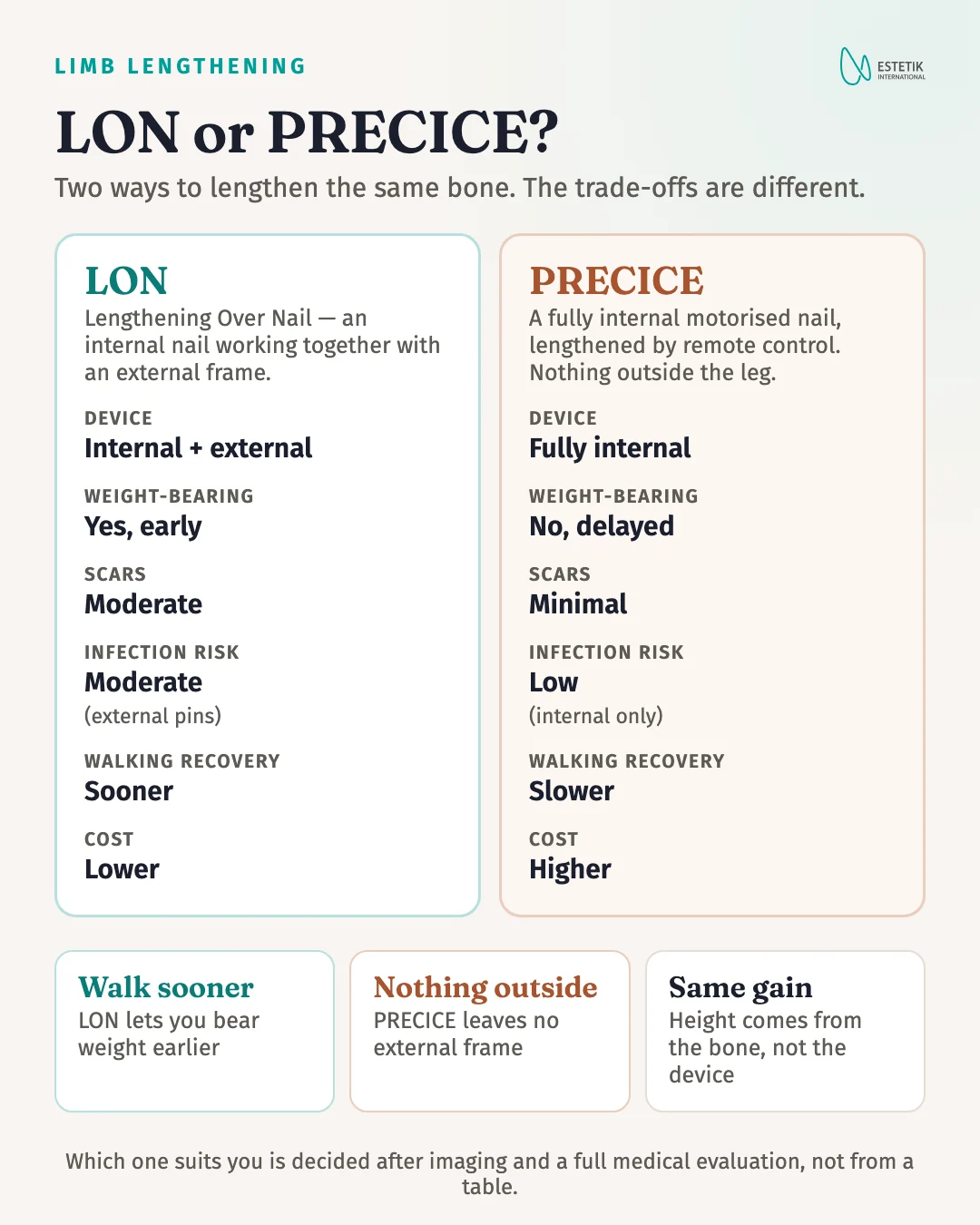
We'll help you choose the method that aligns with your goals, lifestyle, and budget.
Who Is a Good Candidate?
You may be a good candidate for limb lengthening if you:
- Are in good general health
- Have no untreated bone or blood diseases
- Are mentally and emotionally prepared for the process
- Understand the importance of long-term rehabilitation
- Are aged between 18 and 50, though exceptions exist
Our team performs a full medical evaluation and detailed imaging to assess your bone quality, structure, and suitability.
Is It Safe?
Like any surgical procedure, limb lengthening comes with risks such as:
- Infection (especially with external fixators)
- Joint stiffness
- Nerve or muscle irritation
- Uneven bone growth or healing
However, at Estetik International, we minimize risks through:
- Expert orthopedic surgeons
- Precision planning with 3D imaging
- On-site physiotherapy center
- Dedicated international patient care team
Ready to Take the First Step?
Whether you're curious about what's possible, or ready to begin your height transformation, we're here to help. Book an online consultation with our expert team and get a personalized evaluation tailored to your body, goals, and expectations. Arm lengthening is also available — see our arm lengthening page.
Frequently asked questions
One bone segment typically gains 6–8 cm (2.3–3.1 inches). Treating the femurs and tibias in separate stages can reach 13–16 cm (approximately 5–6.3 inches) in total. The realistic figure for you depends on your anatomy, bone quality and how many segments are treated, and it is set after imaging and a full medical evaluation.
Through distraction osteogenesis. The bone is divided surgically, then the two ends are separated very gradually — on the order of a millimetre a day — so the body lays down new bone tissue in the gap. Once the target length is reached, the new bone consolidates and hardens over the following months.
LON combines an internal intramedullary nail with an external fixator, allows earlier weight-bearing and costs less, but needs an external frame during the first phase and leaves moderate scars. PRECICE is a fully internal motorised nail lengthened by remote control, so it leaves minimal scars and carries a lower infection risk, but weight-bearing is delayed and the cost is higher.
It is major orthopaedic surgery and carries real risks: infection (especially with external fixators), joint stiffness, nerve or muscle irritation, and uneven bone growth or healing. These risks are reduced by experienced orthopaedic surgeons, precision planning with 3D imaging, structured physiotherapy and close follow-up — but they cannot be eliminated, so the decision deserves a full discussion with your surgeon.
Generally someone in good general health, with no untreated bone or blood disease, who is mentally and emotionally prepared for a long process and understands that rehabilitation is as important as the surgery. Most patients are between 18 and 50, though exceptions exist. Candidacy is confirmed with a full medical evaluation and detailed imaging.
Yes. Some patients choose simultaneous bilateral lengthening, while others lengthen the tibias first, recover fully, and return later for the femurs. The staged approach spreads the recovery out; the combined approach can yield more total height but comes with significantly more risk and a longer rehabilitation.
Limb lengthening is not a quick procedure. Lengthening itself runs over weeks at roughly a millimetre a day, and the new bone then needs months to consolidate before normal loading. Physiotherapy runs throughout. Your surgeon gives you a timeline based on the method chosen and how many segments are treated.
Talk to our medical team
Share a few details and a patient coordinator will plan your consultation with the right surgeon.