
Why the crown is not the hairline
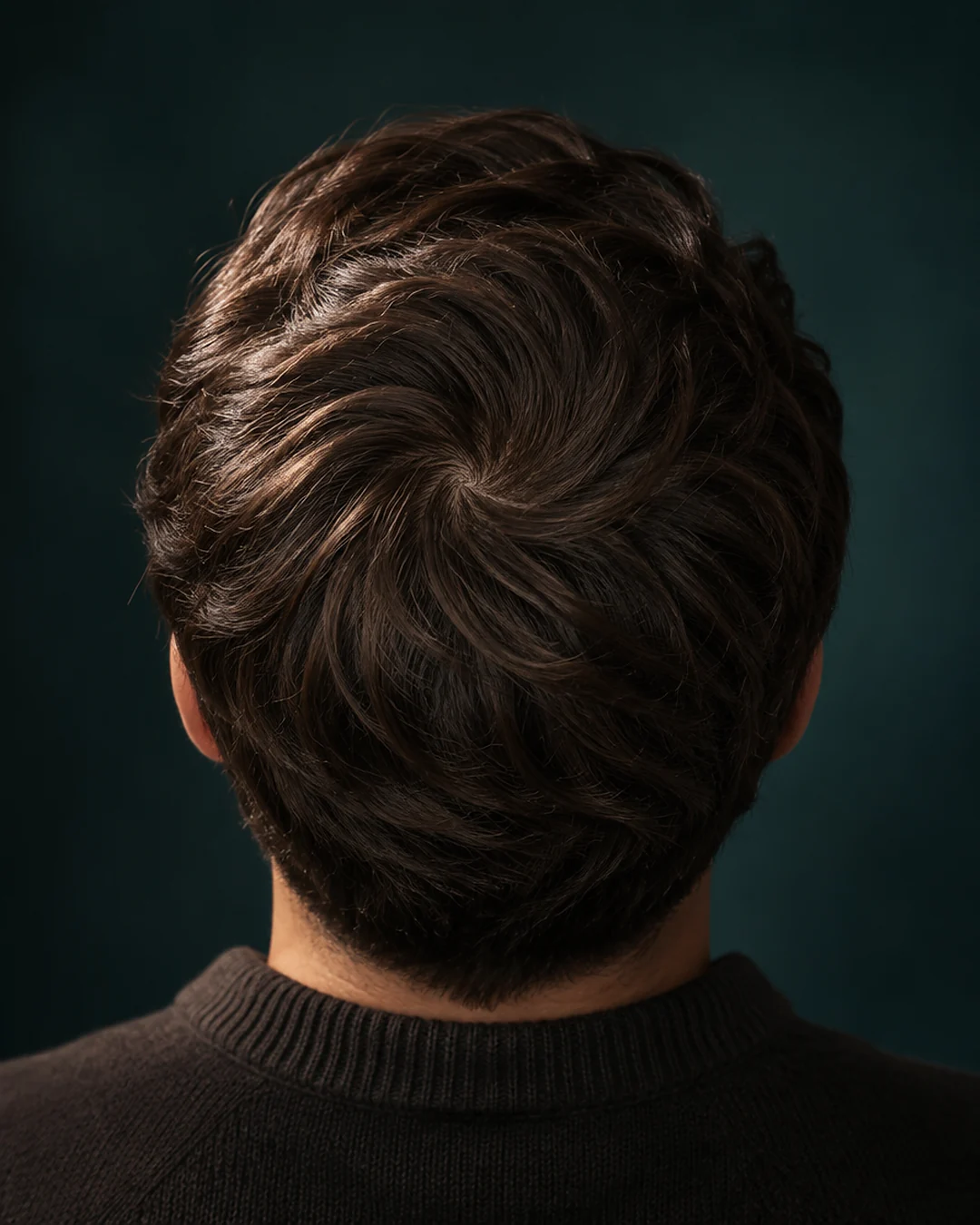
The crown, or vertex, is the one place on the scalp where hair changes direction. Across the front and the mid-scalp the hair lies in a single broad direction, forward and slightly to one side. At the crown it leaves one point in a spiral, the whorl, and fans outward from there in every direction.
That single piece of anatomy causes almost everything that makes this area harder to transplant than the hairline.
- The surface is curved and it faces upward, so it catches overhead light. Thinning shows here before it would show anywhere else, and the same number of grafts looks less dense than it would at the front.
- Every graft needs its own angle. Around the whorl, two grafts a few millimetres apart point in noticeably different directions. Set them all pointing straight back and the result reads as a brush rather than as hair.
- The loss is often still moving. The crown tends to open outward from the whorl over years, which is why a plan that ignores future loss can leave a ring of transplanted hair around a widening centre.
The whorl is read, not invented
Your whorl already has a direction and a centre, and both are fixed. The job is to rebuild what was there, which means mapping the existing spiral at the edges of the thinning and continuing it inward. This is why photographs taken from behind matter more than front-facing ones when the crown is being assessed, and why a plan made from a single selfie is not a plan.
How many grafts does the crown need?
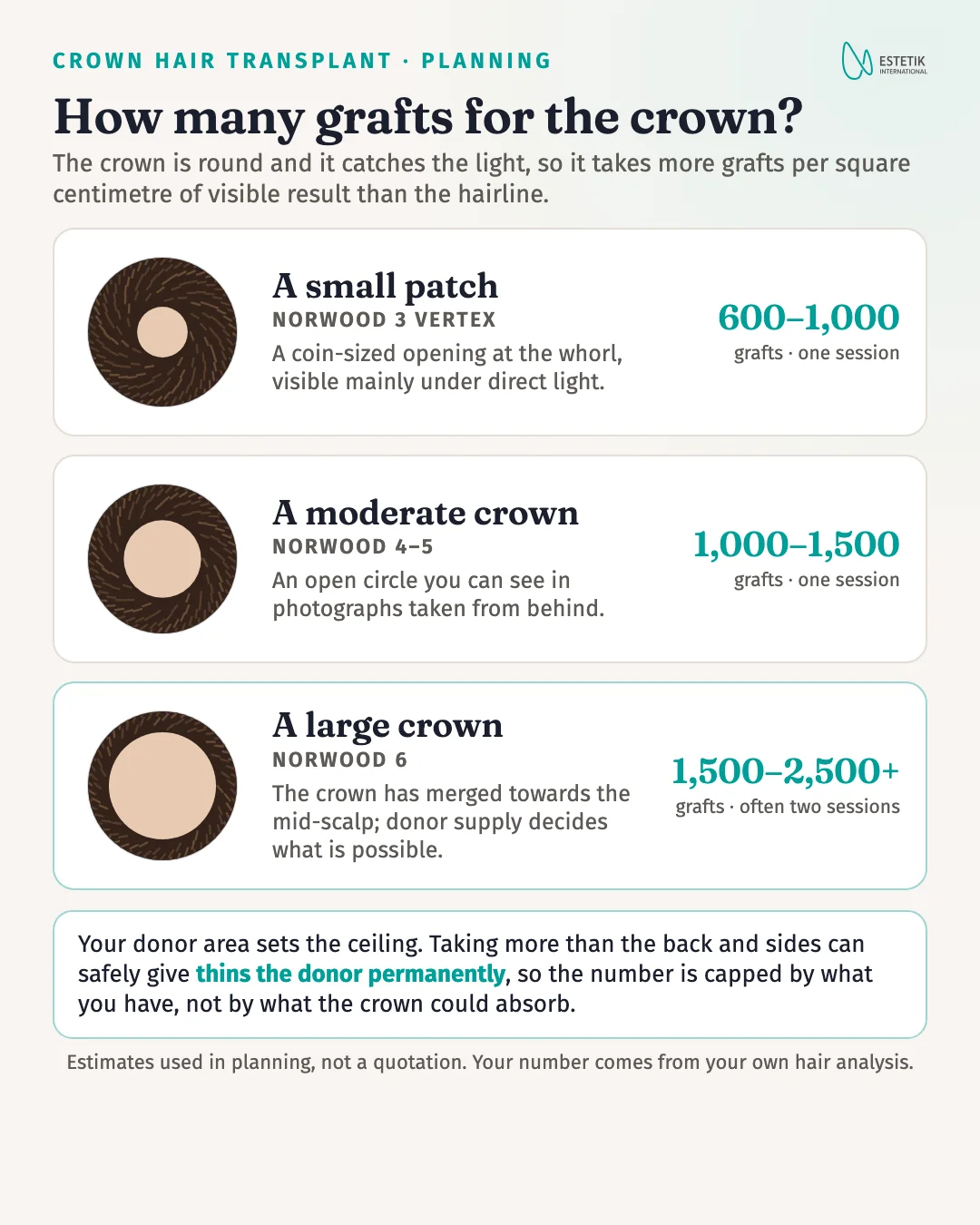
These are the ranges our team works with when planning. They are estimates for discussion, not a quotation, and the number on your own plan comes out of your hair analysis.
| Crown size | Norwood | Grafts | Sessions |
|---|---|---|---|
| A small patch, coin sized at the whorl | 3 vertex | 600 to 1,000 | Usually one |
| A moderate open circle, visible in photographs from behind | 4 to 5 | 1,000 to 1,500 | Usually one |
| A large crown merging towards the mid-scalp | 6 | 1,500 to 2,500 and above | Often two |
It is worth saying plainly that published graft figures for the crown do not agree with each other. Different clinics quote anything from 500 to nearly 3,000 for what they each call a crown, partly because they are measuring different areas and partly because a graft is not a fixed unit: one graft can carry one hair or four. A number quoted to you before anyone has looked at your scalp is a marketing figure, not a surgical one.
Your donor area is the ceiling
The back and sides of the head hold the hair that is genetically resistant to thinning, and that supply is finite. Take more than it can safely give and the donor area itself thins permanently, which is a trade that cannot be reversed.
A 2014 study in Archives of Plastic Surgery measured this in 952 Korean men who had a parietal whorl, out of 1,008 assessed. The authors used the position of the whorl to predict the permanently safe donor area, and found that hair loss mostly progresses within 6 centimetres of the whorl towards the back of the head. They open the paper by noting that there is no known factor that scientifically predicts the rate at which alopecia will progress, which is the honest position: donor planning is a judgement made from your anatomy, not a formula.
Hairline or crown first?
When the donor area cannot cover both at once, something has to be chosen. This is the reasoning most surgeons apply.
| Situation | Usual priority | Why |
|---|---|---|
| Hairline receding and crown opening, limited donor | Hairline | It frames the face, it is seen in every photograph and conversation, and it needs fewer grafts per unit of visible change |
| Hairline intact, loss only at the crown | Crown | There is nothing to compete for and the whole budget can go to one area |
| Both areas affected, generous donor | Both in one session | Possible when the donor supports it, commonly in the region of 3,500 to 4,000 grafts for the two together |
| Under 25 with fast crown loss | Often neither yet | The pattern has not settled; medical treatment first, surgery once the loss is stable |
If you are weighing this up, the two things to bring to the consultation are photographs taken from directly behind under overhead light, and an honest account of how quickly the area has changed over the last two or three years.
FUE, DHI or Sapphire FUE for the crown?
All three techniques are used at the crown and the technique matters less here than the angle work does. The short version:
- FUE suits larger crowns where coverage over a wide area is the goal.
- DHI places each graft directly with an implanter pen, which gives fine control over angle and direction. That control is useful around a whorl.
- Sapphire FUE uses sapphire blades to open the channels, which allows them to be placed closely together.
- Organic hair transplantation adds enriched fat tissue to the recipient area before the grafts go in.
Which one fits depends on the size of the area, your donor supply and whether you want to avoid shaving. We compare the two most asked about in detail in DHI vs FUE.
Crown hair transplant timeline, month by month
This is the part that catches people out. The crown follows the same biological sequence as the hairline, but it reads as a result several months later, because the area is wider and it needs more density before coverage becomes visible.
| When | What is happening |
|---|---|
| Weeks 1 to 2 | Crusts form around each graft and fall away. The area looks worse than it did before surgery. |
| Weeks 2 to 8 | Shock shedding. The transplanted hairs fall out while the follicles stay in place. This is expected. |
| Months 3 to 4 | First new hairs appear, usually at the hairline before the crown. |
| Month 6 | The hairline is starting to read as a shape. The crown is often only beginning. |
| Month 9 | Both areas thickening; the crown is noticeably behind. |
| Months 12 to 18 | The crown reaches its final appearance. This is the point to judge it. |
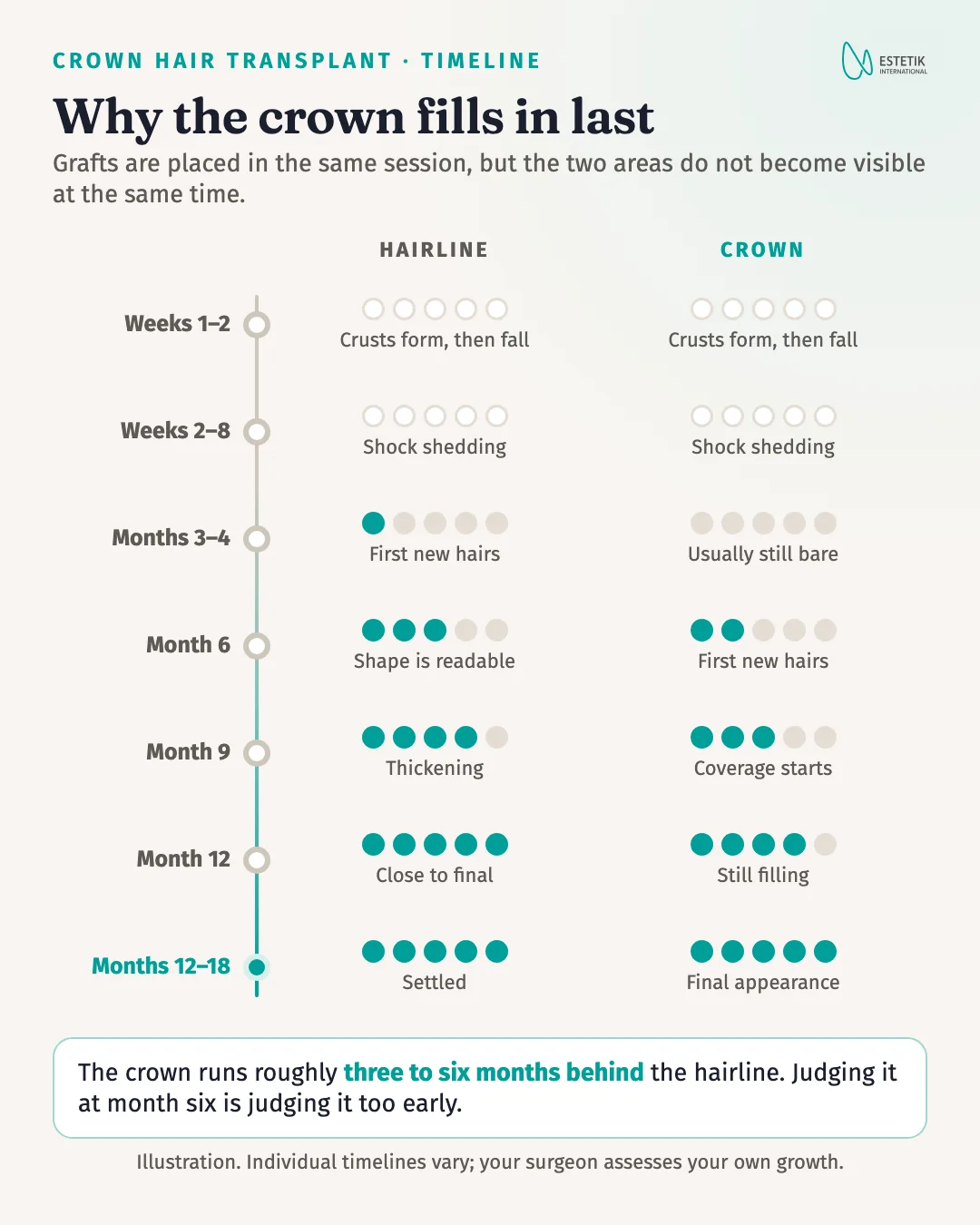
If you look at your crown in a mirror at month six and feel that nothing has happened, that is the normal experience and not a sign that the procedure has failed. Photographs taken from directly behind every two months, in the same light, are far more useful than daily checks in the bathroom.
Crown hair transplant before and after
These are our own patients, photographed from behind so the crown and the whorl are actually visible. Results vary from person to person.
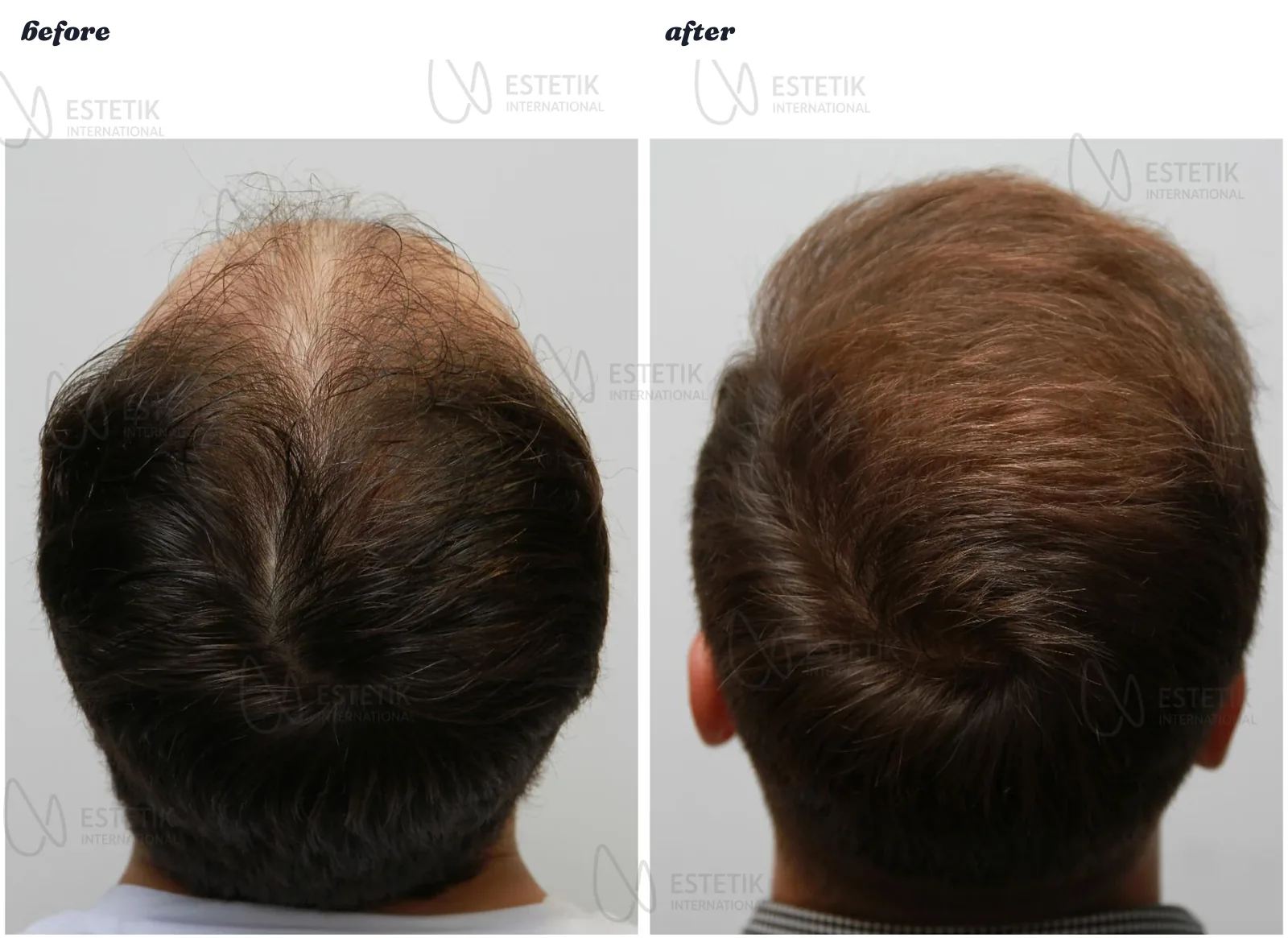
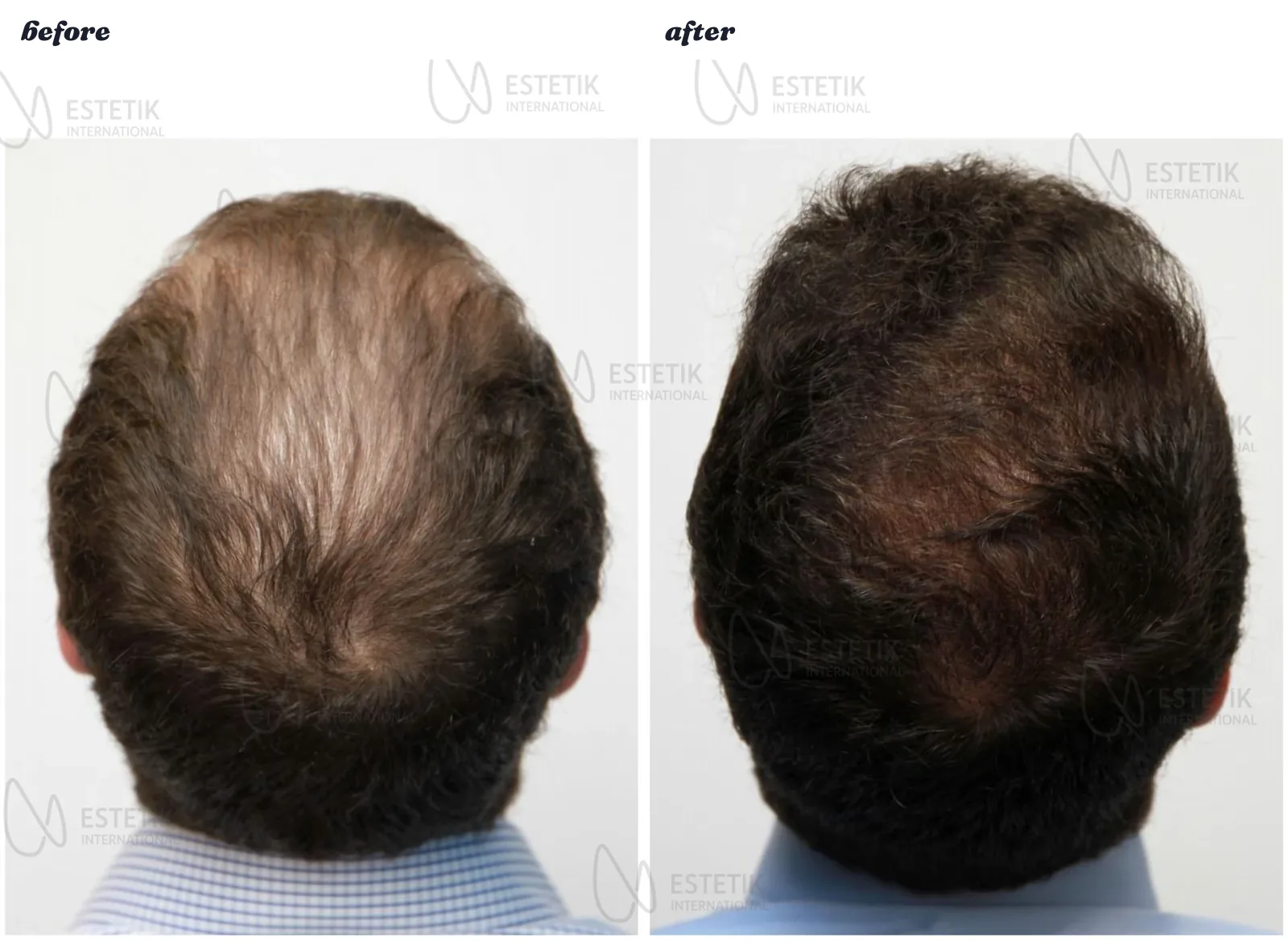
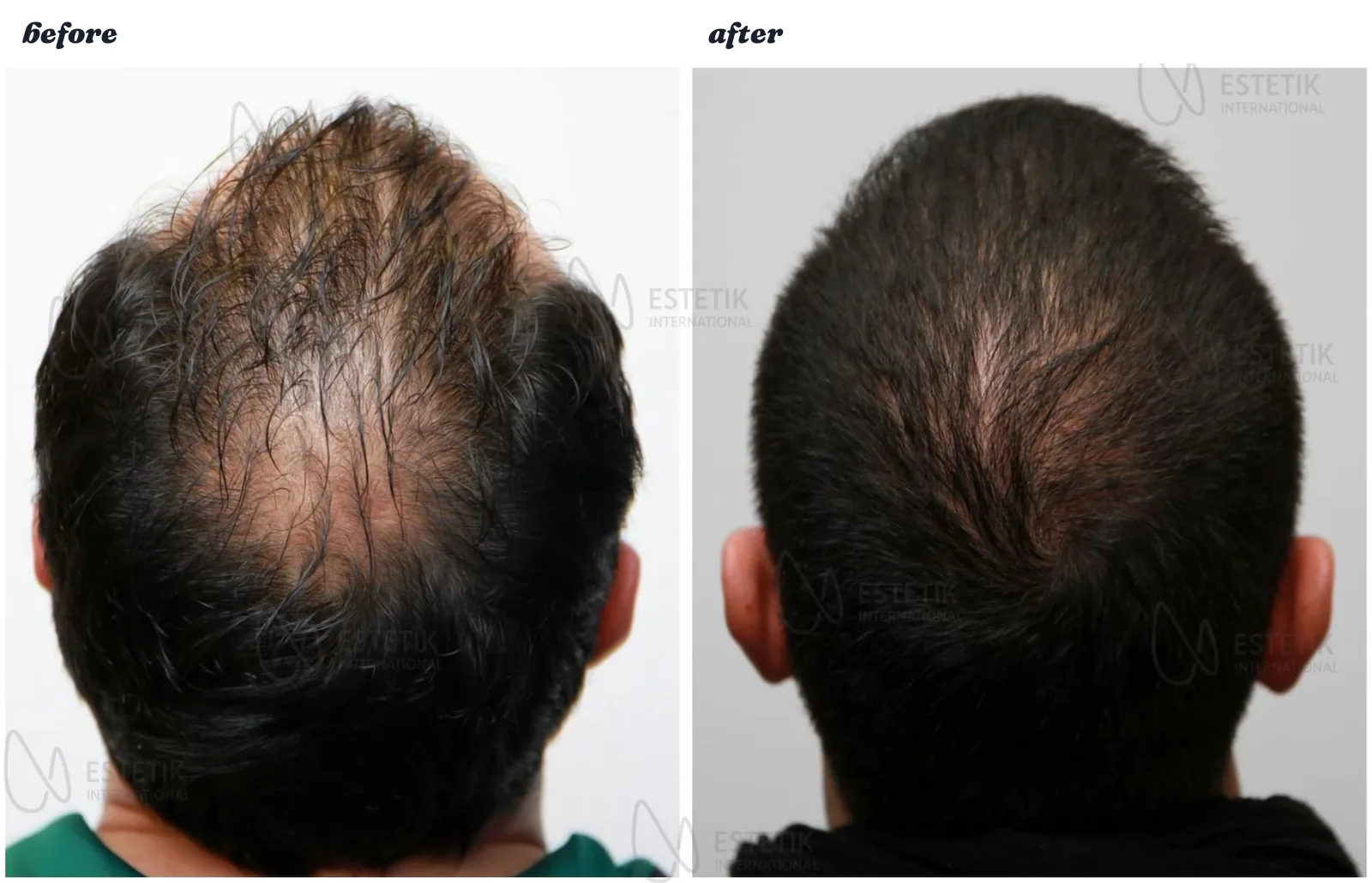
Look at the third set in particular. The whorl still shows a little scalp afterwards, and it should. Hair radiates outward from that single point, so some skin is visible at the centre of every natural crown, including on heads that have never been operated on. A crown photograph with no visible scalp at the whorl at all is usually a photograph taken under flattering light.
Is a crown hair transplant permanent?
The transplanted hair keeps the character of where it came from. Follicles taken from the safe donor area are resistant to the hormone that drives pattern loss, so they continue to grow in their new position.
What is not fixed is the hair around them. Native hair at the edge of the crown can carry on thinning, and if it does, a transplanted centre can end up ringed by a widening gap. This is the reason surgeons are often more conservative at the crown than patients expect, and the reason medical treatment is usually discussed alongside surgery rather than instead of it.
Two of the better studied options both measured their results at the vertex:
- In a two year trial of 1,553 men published in the Journal of the American Academy of Dermatology in 1998, hair counts in a measured circle over the balding vertex rose by 107 hairs at one year and 138 at two years on finasteride 1 mg daily, against placebo, where counts continued to fall.
- A 48 week trial of 393 men published in the same journal in 2002 found 5 per cent topical minoxidil produced a higher non-vellus hair count than the 2 per cent solution and than placebo, with more scalp irritation at the higher strength. The trial was funded by the manufacturer.
Neither is a guarantee and neither suits everyone. Both are prescription decisions for a doctor who has examined you, and both have side effects worth discussing before you start.
How much does a crown hair transplant cost in Turkey?
Our hair transplant packages start from 1,950 euros, and the price is not calculated per graft. That matters more at the crown than anywhere else, because a crown case can need 2,000 grafts or more and a per graft price would climb steeply with it.
What the package covers:
- No graft limit, set by what your donor area can safely give
- Consultation and hair analysis
- Pre-operative blood tests
- The procedure under local anaesthesia
- 2 nights in a four-star hotel
- VIP transfers between airport, hotel and clinic
- Coordinator and interpreter
- First wash and check-up
- Aftercare kit for the first weeks
- Complication insurance
- 12 months of follow-up
Not included: flights, meals, visa fees, a companion's costs and any extra nights. Because flights are not included we do not describe the package as all inclusive.
The stay in Istanbul is three days. Your written plan lists what is covered and what is not before any deposit is taken, and the final figure is set after your hair analysis rather than before it.
What to do next
If the crown is what is bothering you, send photographs taken from directly behind, from above, and of the back and sides of your head so the donor area can be assessed. Our team will tell you what your donor can realistically support, which technique fits, and what the price would be. Nothing is quoted before those photographs are seen.
You can read more about how we work, the four techniques and the clinic itself on our hair transplant in Turkey page.
Scientific references
- Park JH, Na YC, Moh JS, Lee SY, You SH. Predicting the Permanent Safe Donor Area for Hair Transplantation in Koreans with Male Pattern Baldness according to the Position of the Parietal Whorl. Archives of Plastic Surgery, 2014;41(3):277-284
- Kaufman KD, Olsen EA, Whiting D, et al. Finasteride in the treatment of men with androgenetic alopecia. Journal of the American Academy of Dermatology, 1998;39(4 Pt 1):578-589
- Olsen EA, Dunlap FE, Funicella T, et al. A randomized clinical trial of 5% topical minoxidil versus 2% topical minoxidil and placebo in the treatment of androgenetic alopecia in men. Journal of the American Academy of Dermatology, 2002;47(3):377-385
Frequently asked questions
Most crowns fall between 600 and 2,500 grafts. A coin sized patch at the whorl is usually 600 to 1,000, a moderate open circle 1,000 to 1,500, and a large crown merging into the mid-scalp 1,500 to 2,500 or more. The number is confirmed only after your scalp and donor area have been assessed.
First new hairs usually appear at month three or four, coverage starts to read at around month nine, and the crown reaches its final appearance between 12 and 18 months. Judging it at six months is judging it too early, which is the most common reason patients worry unnecessarily.
It is not biologically slower. The crown is a wider, curved surface that faces the light, so it needs more density before the eye reads it as coverage. The same growth that is already visible at the hairline is still invisible at the crown for another few months.
Yes. If your hairline is intact and the loss is confined to the vertex, the whole graft budget can go to the crown. Your surgeon will still look at the hairline and mid-scalp to judge whether the pattern is likely to progress there later.
Often yes, when the donor area supports it. Treating both together commonly falls in the region of 3,500 to 4,000 grafts. Where the donor is limited, the hairline is usually prioritised because it frames the face and needs fewer grafts for a visible change.
A large crown at Norwood 6 often does, with the second session placed once the first has matured, usually after 12 months. A small or moderate crown is normally completed in one. Your surgeon should tell you at the consultation if a second session is likely.
Transplanted follicles come from the resistant donor area and keep growing in their new position. The native hair around them can continue to thin, which is why medical treatment is often discussed alongside surgery. No clinic can promise that the surrounding hair will stay.
Our packages start from 1,950 euros and are not priced per graft, so a crown needing 2,000 or more grafts does not cost more on that basis. The package includes the procedure, two nights in a four-star hotel, transfers, coordinator, aftercare and 12 months of follow-up. Flights are not included.
Talk to our medical team
Share a few details and a patient coordinator will plan your consultation with the right surgeon.