

What Is Hair Loss Treatment?
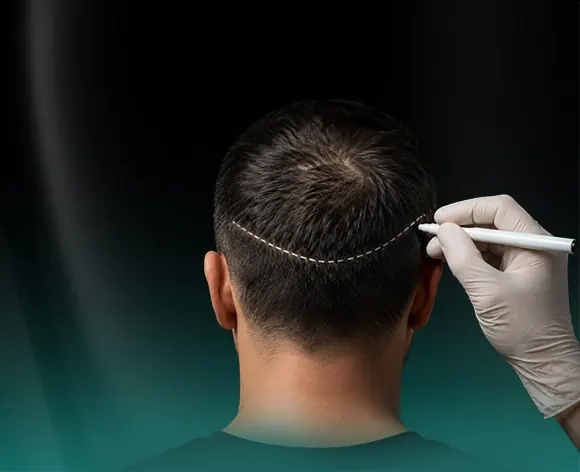
Hair loss is rarely noticed in the mirror — it is noticed on the pillow and in the shower drain. The first question is almost always the same: “Do I need a transplant?” Yet not every kind of shedding calls for surgery: as long as the scalp — the ground the hair grows from — still holds living follicles, the right move is to strengthen that ground first.
Hair loss treatment is not a single procedure. Hair mesotherapy, PRP, exosomes and LLLT hair laser all serve the same purpose: to support the nourishment of the roots, the circulation of the scalp and the growth cycle of the follicle. The aim is not to place a new root, but to extend the life of the roots you still have, thicken fine hair and slow shedding down.
At Estetik International, hair loss treatment is not a single application. Hair mesotherapy, PRP hair treatment, low-level laser therapy (LLLT) and exosome hair treatment are planned individually or together as the Reversa® (ELP) package, according to the type of shedding, age, hormonal picture and scalp examination.
Who Is Hair Loss Treatment For?
These applications deliver the greatest benefit while the root has not yet been lost for good. They are particularly suitable for:
people whose hair is beginning to thin, without a visible bald area yet
men noticing thinning at the crown (early androgenetic hair loss)
women whose parting is widening — in women, diffuse thinning must be supported before any transplant
people with sudden shedding after childbirth, surgery, a febrile illness or intense stress (telogen effluvium)
people whose hair has weakened after rapid weight loss, a change of diet or low iron/ferritin
Hair Mesotherapy
Hair mesotherapy delivers a blend of vitamins, minerals, amino acids, hyaluronic acid and peptides directly into the upper layer of the scalp using micro-needles. The difference from oral supplements is simple: the substance is placed right beside the follicle, without waiting for the long journey through the bloodstream.
Before the session the scalp is cleansed and, if preferred, a topical anaesthetic cream is applied. The blend is delivered at a depth of 2–4 mm through many small injections a few millimetres apart. The session takes 20–30 minutes on average, leaves no needle marks, and the patient returns to daily life the same day.
The first change patients notice is usually less shedding; most feel it within 3–4 weeks. Thicker strands and a fuller look become clearer as sessions progress, most often within 2–3 months.
PRP Hair Treatment
PRP (Platelet Rich Plasma) is the injection into the scalp of plasma concentrated in growth factors and obtained from the patient’s own blood. Since no foreign substance is introduced, the risk of allergy or intolerance is all but nil.
An average of 10–20 ml of blood is drawn from the arm; the platelet-rich plasma is separated in a centrifuge in dedicated tubes and then delivered by micro-injection into the shedding areas. The whole procedure takes 30–45 minutes.
The growth factors inside the platelets (PDGF, VEGF and IGF-1 among others) support cellular activity around the follicle and capillary circulation. In practice, follicles that had entered the resting phase return to the growth phase, and fine strands thicken.
Hair Laser Treatment (LLLT — Low Level Laser)
LLLT (Low Level Laser Therapy) applies low-energy red light to the scalp. It does not cut, does not burn and causes no tissue damage — which is why it is also called a “cold laser”. Its effect runs through the mitochondria: cellular energy production rises, microcirculation around the follicle improves and the hair’s growth phase lengthens.
The patient sits under the laser head; the application is painless and contact-free. A session takes 15–20 minutes on average and leaves neither redness nor downtime.
Used regularly, LLLT slows shedding and improves hair quality; on its own, however, it works slowly. Performed immediately after injectable treatments, it helps the tissue make better use of the growth factors and nutrients delivered. That is precisely why, in the Reversa® protocol, the laser follows the injection.
Exosome Hair Treatment
Exosomes are 30–150 nanometre vesicles that cells release to carry messages to one another. They contain growth factors, signalling proteins and microRNA. In hair applications the goal is not to transfer cells into the scalp, but to deliver these messenger molecules — and with them the signal to get back to work — to the follicle.
PRP is obtained from the patient’s own blood, so its content varies with that day’s blood values. Exosome preparations, by contrast, are standardised products made under laboratory conditions, with a higher density of signalling molecules and no blood draw required. Exosomes are therefore chosen above all when the response expected from PRP remains limited, or when PRP is unsuitable because of blood values.
The exosome solution is applied by micro-injection, much like mesotherapy, or after micro-needling; the session takes 20–30 minutes. As this is a relatively new chapter in hair medicine, the response can differ from person to person: at Estetik International exosomes are not offered as a standalone “miracle treatment”, but as part of a protocol drawn up once the type of shedding has been identified.
When Should Reversa® Be Applied?
Hair is among the organs that report stress with the longest delay: it shows up as shedding 2–3 months after the triggering event. The most productive window for Reversa® is therefore not the peak of shedding, but the period right after the trigger.
1. At the turn of the seasons
The hair cycle follows the seasons; in autumn especially, the share of hair in the resting phase rises and shedding becomes obvious. The autumn and spring courses are scheduled to fall on these two transitions.
2. After hormonal change
The postpartum period, the end of breastfeeding, the menopausal transition, starting thyroid treatment or changing contraception all act directly on the hair cycle. In these phases the follicle is not lost — only its cycle is disturbed, and this is exactly where supportive treatment pays off most.
3. After starting or ending a diet
A gain or loss of more than 10 kilos in the last 3 months predictably leads to hair shedding. In rapid weight loss, protein, iron, zinc and B12 intake all drop; follicles switch to energy saving and enter the resting phase together. After bariatric surgery or during aggressive dieting, Reversa® is used to limit that loss.
4. After heavy sun exposure
Intense UV exposure weakens the keratin structure of the hair shaft and creates oxidative stress on the scalp. Part of the complaints that begin at the end of summer start here; the autumn course targets this picture as well.
5. When your living environment changes
Moving city is not only a change of address: water hardness, altitude, humidity, air pollution, diet and sleep hours all change at once. Shedding seen in the first months after moving abroad or to another city often comes down to this adjustment.
If one of these five applies to you, a scalp assessment is advisable before the shedding worsens. The aim of a protocol started early is not to bring back hair already lost, but to limit the loss from the outset.
Which Treatment Suits Whom?
Declining hair quality, vitamin/mineral deficiency — Hair mesotherapy — Course of weekly sessions + monthly maintenance
Early androgenetic hair loss — PRP — Sessions as a course + maintenance
Slowing shedding, preserving strand thickness — Hair laser (LLLT) — Regular, repeated sessions
Limited response to PRP, a stronger stimulus needed — Exosomes — Number of sessions set after examination
Heavy shedding after a trigger (hormones, diet, relocation, sun) — Reversa® package — 1 session a week × 3, in autumn and spring
Root lost, a bald area formed — Hair transplant — Surgical planning + supportive treatment afterwards
Using It Alongside a Hair Transplant
Hair loss treatment and hair transplantation are not alternatives; they complete each other. A transplant only changes the area where roots have been placed; the existing hair beside it keeps shedding on its own cycle. Without support, a few years later the picture can become “dense transplanted area, thin surroundings”.
Before the transplant: scalp circulation and tissue quality are improved so the operation takes place on healthier ground.
After the transplant: applications begin once the healing period set by the surgeon is complete; they support graft survival and the existing hair around it.
Long term: two courses a year help preserve the transplant result over the years.
What Affects the Result?
The response to hair loss treatment differs from person to person. The main factors are:
the type and duration of shedding — treatment started before the root is lost responds better
the hormonal picture (androgenetic predisposition, thyroid, PCOS)
iron/ferritin, B12, vitamin D and zinc levels
smoking, sleep pattern and chronic stress
adherence to the protocol — sessions completed at the recommended intervals
Tips Before Hair Loss Treatment
What to consider before the protocol begins:
Have a scalp analysis done; without identifying the type of shedding, the right protocol cannot be built.
If your doctor asks for it, have ferritin, B12, vitamin D, zinc and thyroid values checked — where a deficiency underlies the shedding, that is corrected first.
Report every medication you take, especially blood thinners and hormone therapy.
In the days before the session, avoid harsh chemical treatments on the scalp (colouring, keratin, peeling).
Be clear about the expectation: the goal is not to bring back a lost root, but to protect and strengthen the ones you still have.
Treatment Day: The Reversa® Session Step by Step
The session starts with assessment and cleansing of the scalp; a topical anaesthetic cream is applied if needed.
For PRP, an average of 10–20 ml of blood is drawn from the arm and the platelet-rich plasma is separated in a centrifuge.
The prepared PRP is delivered by micro-injection into the affected areas.
The exosome solution is then applied to the scalp using the same technique.
In the final stage the LLLT hair laser is applied; this stage is painless, contact-free and takes 15–20 minutes.
The full session averages 45–60 minutes; no dressing is needed and you return to daily life the same day.
Tips After Hair Loss Treatment
To get the most out of the session:
Do not wash your hair in the first hours; follow the interval your doctor gives.
Mild redness and tenderness at the injection points are normal and usually settle within a day or two.
Avoid strenuous exercise, sauna, steam room and tanning beds on the same day.
Do not apply harsh chemical treatments to the scalp for a few days.
Complete the sessions at the recommended intervals — the strength of the protocol lies in its continuity.
Patient stories
 Organic Hair Transplant · DEGorgeous Hair Loading!As a young man, baldness can make you look older. Our dear patient Andreas, decided to say “stop” to baldness and chose Estetik International to get his organic hair transplant done by our experts. Check his story and see how he decided to come with his friend to Istanbul to get their new hair.Watch on YouTube
 Organic Hair Transplant · AUYouth and ConfidenceAll the way from Australia, Anthony came to Estetik International to turn back the clock and get his young appearance back through our Organic Hair Transplantation. Check out his experience.Watch on YouTube
 Organic Hair Transplant · CAJoyful Experience!From the Canada, Amish came to Estetik International to fill in the blanks… in his hair! You can see in his beautiful smile how his experience was satisfying. Check out the video!Watch on YouTube
Frequently asked questions
A slight sting may be felt during injection; a topical anaesthetic cream is used if needed. The laser stage is entirely painless. Painkillers are generally not required afterwards.
The hair cycle swings with the seasons, and shedding becomes most obvious in autumn. Placing the courses on these two transitions means entering the period of increased shedding with support already in place.
Less shedding is usually noticed within the first weeks. Thicker strands and a fuller look appear 2–3 months after the course ends; after the second course, progress is assessed on comparison photographs.
Because injections are made into the scalp, washing is not advised in the first hours. Your doctor will give an exact interval depending on the product used; most patients return to their usual washing routine the next day.
Yes. The timing is set by the surgeon who performed the operation, and no application is made before healing is complete.
These applications are not scheduled during pregnancy or breastfeeding. For postpartum shedding, the appropriate timing is determined at the medical examination.
Blood thinners, blood disorders and certain chronic therapies require assessment before PRP. In such cases the doctor adjusts the protocol or chooses alternatives that do not require a blood draw.
Your surgical team
Considering Hair Loss Treatment?
Share a few details and a patient coordinator will plan your consultation with the right surgeon.